

Every few years, blogs get pronounced dead.
Social media is faster. Video is king. No one reads long-form content anymore.
I’ve been blogging for over fifteen years, long enough to have heard this argument many times, and long enough to know it doesn’t quite hold up. Blogs aren’t dead. What is dead is unfocused, unclear content that exists because someone has been told they “should be blogging”.
When blogging works, it works quietly and over time. And often in ways you don’t expect.
What years of blogging taught me about visibility
One of the most visited blog posts on my website has nothing to do with my core photography work.
It’s seasonal, very specific, and taps into a topic people reliably look for every year. That single article brings in around 30,000 views annually. While that traffic isn’t directly aligned with my regular offers, it taught me something crucial: when content genuinely answers a real question people are already asking, search engines keep putting it in front of them — year after year.
Instead of dismissing that traffic as “not ideal”, I created a product specifically for the people landing on that article. The blog didn’t just bring attention; it revealed an opportunity and ended up making me money.
At the other end of the spectrum are blog posts that are directly aligned with my ideal clients. One example is my article about what to wear for professional headshots. I wrote it two years ago, and it’s just as relevant today as it was then. It doesn’t go viral. It doesn’t spike dramatically. But it gets steady clicks every month because it addresses an evergreen concern — one that people actively search for when they’re considering working with someone like me.
Those two posts look very different on the surface, but they succeed for the same reason: relevance.
Why blogging still matters for small businesses
At its core, blogging does something very simple: It helps search engines — and now AI tools — understand what you do, who you help, and what problems you’re equipped to solve.
Google can only work with what you give it. If your website consists of a homepage, an about page and a services page, there’s very little context for it to draw from. A blog allows you to go deeper. It gives you space to answer questions, explain your thinking, and show your expertise in action.
And increasingly, this matters not just for traditional search, but for large language models (ChatGPT, Claude etc) as well. People don’t only type keywords into Google anymore. They ask full questions. If your content clearly answers those questions, you’re far more likely to be found — whether that’s on Google or in an AI-generated response.

What actually makes a blog post work
The biggest mistake I see small businesses make with blogging is writing content that’s technically “correct” but emotionally disconnected.
Effective blog posts usually start with a very simple question: what is my ideal client trying to figure out right now?
That might look like confusion, hesitation, comparison, or doubt. It might be something they’re embarrassed to ask out loud. It might be something they’ve half-Googled late at night.
When someone clicks on your blog post, you’re making a promise. Your headline sets the expectation. Your job is to fulfil it.
This matters more than clever wording, keyword stuffing, or chasing trends. If your article doesn’t actually answer the question it claims to address, search engines notice — and over time, they stop showing it.
I’m not an SEO expert, but I’ve seen this pattern repeat often enough to trust it: clarity beats optimisation every time.
And if you’re not sure what to write about because you’re genuinely stuck on content ideas…
- Use tools like Answer The Public
- Start typing something from your niche into Google and look at the suggestions
- Ask tools like ChatGPT or Claude: “What are common fears, objections and misconceptions for [my ideal client]?”
How long should a blog post be?
There’s no perfect word count – even though SEO will tell you otherwise.
Some questions need a short, focused answer. Others require context, nuance, and reassurance. The goal isn’t to write more — it’s to write enough.
Enough that the reader feels understood.
Enough that they don’t need to open another tab.
Enough that the promise you made at the start feels genuinely fulfilled.
Using images as proof, not decoration
Images play a much bigger role in blogging than simply breaking up text.
They show how you work. They build trust. They help readers imagine themselves working with you.
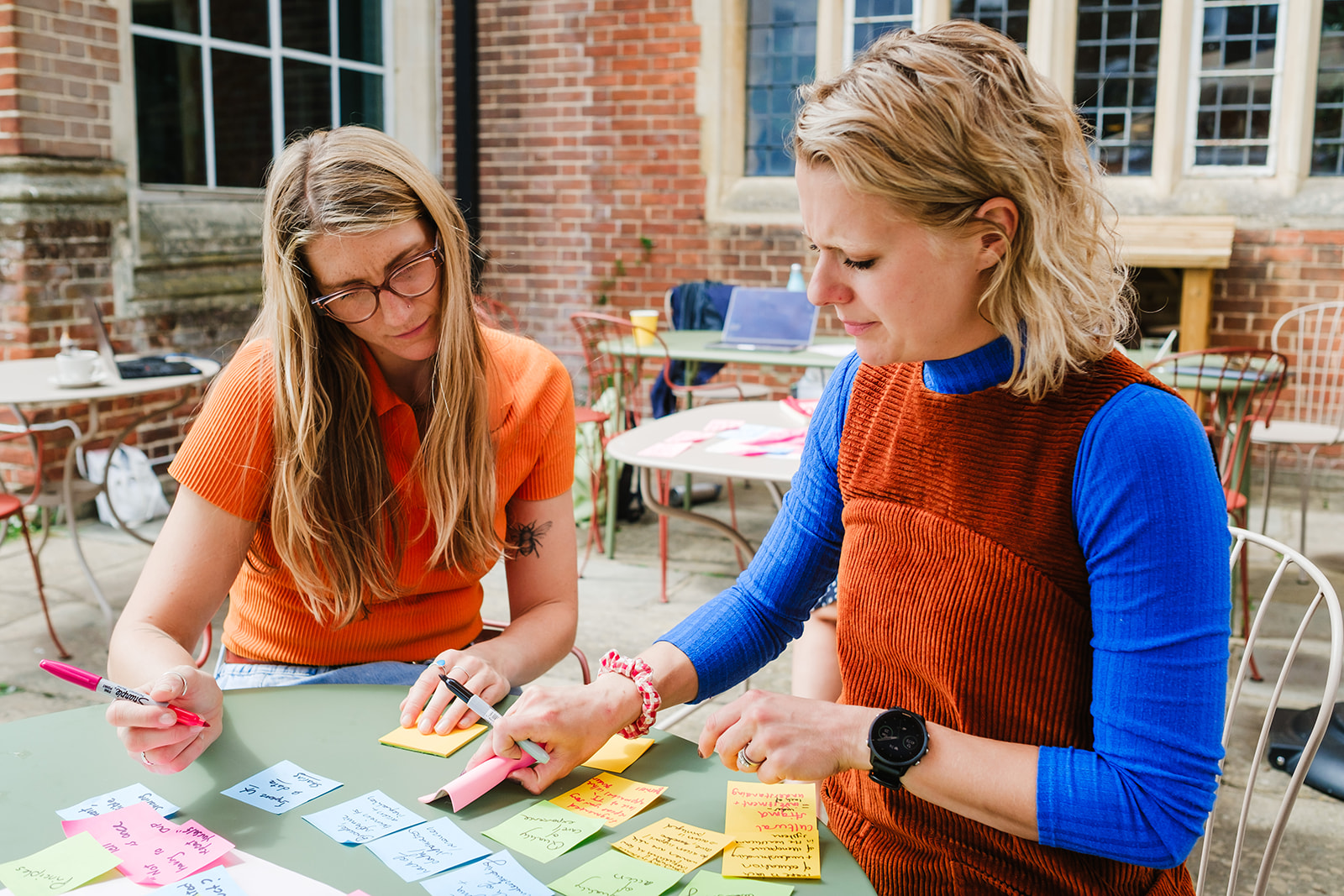
When I write blog posts, I don’t think of images as filler. I think of them as evidence. Client stories paired with real images are especially powerful because they show your process, not just the end result.
If you don’t yet have images that support what you’re writing about, my advice is simple: don’t default to generic stock photos. They dilute your message and make your work feel interchangeable. Instead, notice where images would strengthen your content and treat that as a signal. That’s often the moment when personalised brand photography becomes genuinely useful, rather than decorative.


Blogging, AI and being understood
Blogging today isn’t just about ranking for keywords. It’s about being understood.
Search engines and AI tools are trying to identify patterns: what you consistently talk about, what problems you address, and who your work is for. The clearer and more focused your content is, the easier it becomes for these systems to connect you with the right people.
This is also where many blogs fall apart.
If you’re unclear about who you’re serving, your content will feel scattered. And if it feels scattered to a human reader, it will be even harder for algorithms to place you.
Where brand clarity comes in
Successful blogging isn’t really about blogging.
It’s about knowing who you’re speaking to, what they care about, and why your perspective matters. Once that’s clear, content ideas stop feeling forced. Your message sharpens. And your website starts doing some of the heavy lifting for you.
That’s why ideal client work is a core part of my AI Brand Clarity Blueprint. Without that foundation, it’s hard to create content that’s findable, relevant, and sustainable — whether you’re writing for Google, AI tools, or real people.

Your Brand Clarity Blueprint is a guided workbook that helps you uncover who you are as a brand, who you’re speaking to, and how to communicate that clearly and confidently.
A final thought
New businesses often underestimate the long-term impact of blogging.
Not because they don’t value content, but because they expect immediate results. Blogging is slower than social media, but it’s also sturdier. A well-written, relevant post can keep working for you years after you hit publish. On Social Media, posts disappear within hours, sometimes even minutes. How’s that for longevity?
If your website currently gets little to no traffic, it’s rarely because your work isn’t good enough. More often, it’s because the right questions aren’t being answered — or not clearly enough.
That is something you can change.
And with the right photos, it won’t just read well – it’ll also look fantastic.
So if you’re realising that what you’re missing now are images that truly support your content, please get in touch. I help businesses create brand images that do more than just look nice — they help tell the right story.